GMAC Bring-Up Debug Strategies
2 minute read
The most important are these three parts, none can be missing.
a. Power
Schematic Diagram
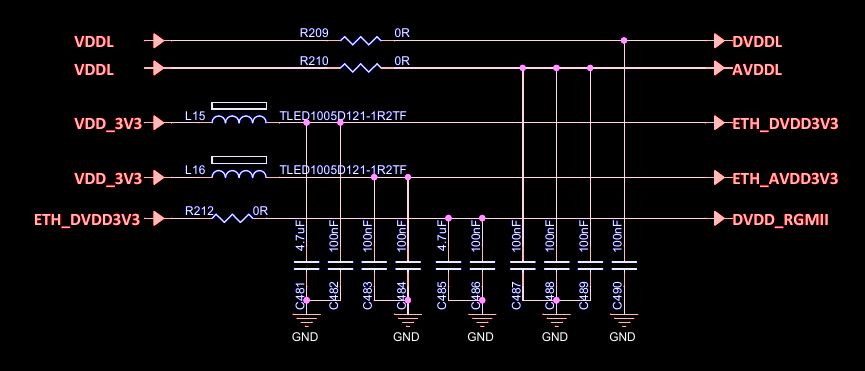
Description
The power supply must be present first, and it must be normal.
The definition of “normal” is in the datasheet.
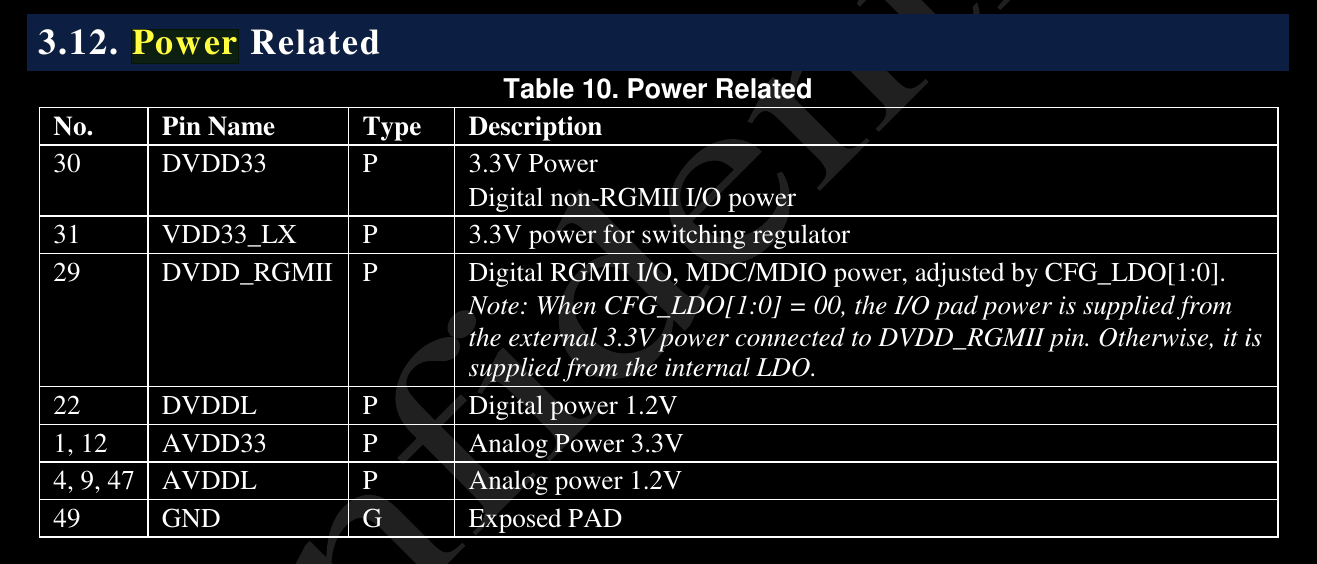
Category 1: AVDDL and DVDDL
- Requires around 1.2V
- The voltage requirement for R209 and R210 is around 1.2V
Category 2: DVDD33, VDD33, and AVDD33
- Requires around 3.3V
Category 3: [Special][Caution] DVDD_RGMII
Digital RGMII I/O, MDC/MDIO power, adjusted by CFG_LDO[1:0].
	Note: When CFG_LDO[1:0] = 00, the I/O pad power is supplied from
	the external 3.3V power connected to DVDD_RGMII pin. Otherwise,
	it is supplied from the internal LDO.
- Test Method
- By testing pins 36 and 37 of the PHY After testing, it was found that both are at a low level.
- Testing R212 After testing with a multimeter, it was found that both ends are at 3.3V.
b. Crystal (Clock)
1. XTAL_I (Input pin related to the crystal)
- This pin is grounded, so there is nothing.
- This is pin 47 of the PHY.
2. XTAL_O (Output pin related to the crystal)
- 25MHz is measured from here.
- How to test?
- Directly test pin 46 of the YT8521SC.
These two must come first, as they determine if the crystal is present.
Once that is confirmed, then look at MDIO. These two are related to the circuit that controls the PHY (YT8521SC) from the MAC (inside RK3568). One is the clock and the other is data. Both must be present.
3. MDC (MDIO Clock)
Test Method
- Directly test pin 14 of the PHY, there is no other way.
Correct Result
- 3.3V or close to it.
Incorrect Result
- Significantly lower than 3.3V, for example, below 1V.
4. MDIO (MDIO Data)
Test Method
- Test pin 15 of the PHY.
Correct Result
- 3.3V or close to it.
Incorrect Result
- Significantly lower than 3.3V, for example, below 1V.
c. Reset
RESET_N (Reset pin)
In the DTS, it is:
- The
snps,reset-gpiostatement.
- The
Test Method
- One can test R205
- Or directly test pin 13 of the PHY
- One can test R205
Correct Result
- It pulls low once at power-on, then pulls high.
- It pulls low once at power-on, then pulls high.
Incorrect Result
- Does not pull low, or stays low continuously.
It is very important to distinguish who provides the clock to whom, and who performs the frequency multiplication. Generally, there are two groups: who provides the original 25MHz, who does the frequency multiplication, and is it provided to anyone after multiplication?


